Each year, the Fashion Scholarship Fund invites students to engage with a real-world industry challenge as part of the Scholarship application process. Through the FSF Case Study Competition, students apply creativity, research, and strategic thinking to understand how fashion operates beyond the classroom and within a global industry in constant evolution.
For 2026, Scholars explored how fashion intersects with other industries by developing strategic collaborations with non-fashion partners across Business Strategy, Design and Product Development, Marketing, and Merchandising. The work focused on how fashion can drive innovation and growth across sectors, including technology, hospitality, wellness, entertainment, and transportation.
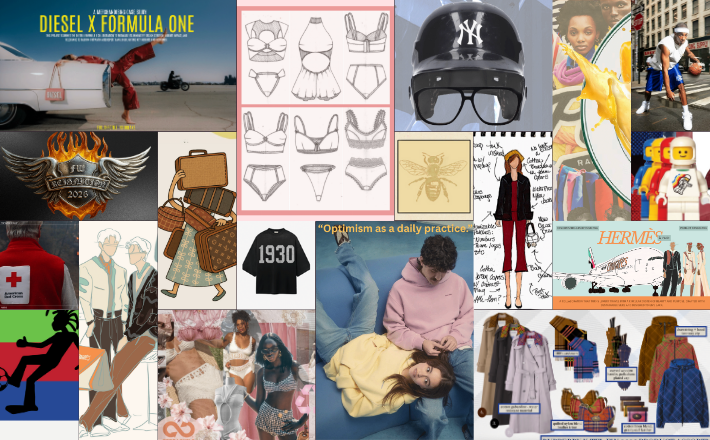
Across 160 case studies, recurring themes emerged in how students approached collaboration, product development, sustainability, wellness, fandom, and community impact. These patterns appeared across disciplines and institutions, reflecting shared perspectives on the future of the fashion industry.
This FSF Trend Report highlights the six biggest trends that emerged from the 2026 Case Study Competition. These trends reflect how Scholars are thinking, building, and problem-solving as future leaders of the industry.
TREND 1: COLLABORATION AS A LONG-TERM STRATEGY
While every 2026 case study required a collaboration between a fashion brand and a non-fashion partner, many Scholars took the idea further. Rather than building one-off concepts, they designed partnerships meant to function over time, supporting product development, audience access, distribution, and storytelling.
Projects like Comfort in Motion by Jazmin Hernandez Arceo from The University of Texas at Austin explored how apparel could support new forms of mobility through a collaboration between SKIMS and WAYMO. Redefining Luxury in Motion by Fatoumata Cisse from the University of Southern California positioned travel as an extension of luxury craftsmanship through a partnership between Hermès and Emirates. Made to Play by Claire Galli from Marist College, framed circular design as a shared system between Coachtopia and LEGO, built for reconfiguration and longevity.
These case studies show partnerships functioning as part of the business model, not as standalone concepts.
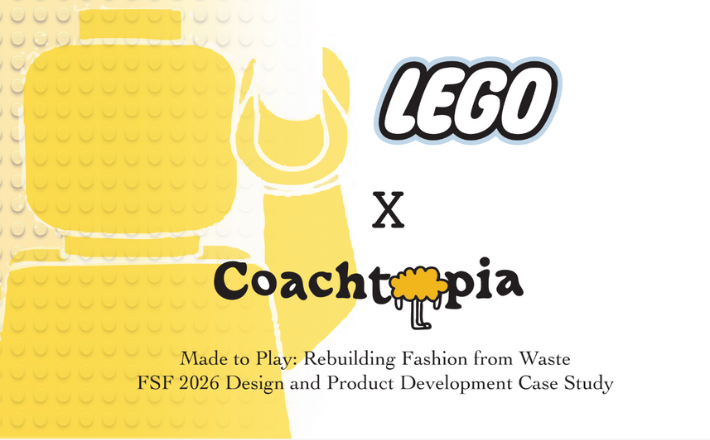
A playful collaboration between Coachtopia and LEGO, Made to Play by Claire Galli reimagines accessories as modular, customizable pieces that invite creativity, reuse, and personal expression—just like building with LEGO bricks.
TREND 2: GENDER-INCLUSIVE DESIGN AS STANDARD PRACTICE
Gender-inclusive design was a consistent starting point across the 2026 case studies. Scholars emphasized function, comfort, and personal expression, aligning their work with how today’s consumers actually use and experience fashion.
Andy Trinh of the University of Southern California explored cultural identity and craftsmanship in Luxury Meets Mechanical Soul through a Chrome Hearts-Harley-Davidson concept. Heritage in Motion, by Annelise McDonald from the University of Wisconsin–Madison, presented outerwear as an everyday uniform through a partnership with Burberry and Transport for London. In Civil Suit: Redefining Standards, Aalona Snell of Drexel University reimagined modern tailoring through a Fear of God and Cadillac collaboration, using gender-inclusive suiting to challenge traditional power dressing and expand who luxury is designed for.
These projects treated inclusivity as design logic. Gender neutrality appeared through silhouette choices, styling systems, and use cases grounded in daily life.
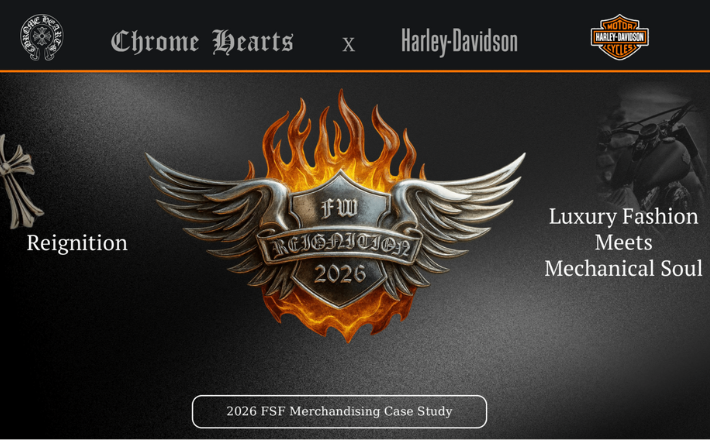
A gender-inclusive Chrome Hearts and Harley-Davidson capsule, Andy Trinh’s Luxury Meets Mechanical Soul places fashion inside transportation through authenticity, function, and long-term value.
TREND 3: WELLNESS EMBEDDED INTO PRODUCT AND EXPERIENCE
Wellness showed up in how Scholars thought about everyday life. Their work supported mental health, physical performance, and recovery through both design and strategy.
In Wear Your Calm, Andrea Palencia of Marist College developed a collaboration between Madhappy and Headspace centered on emotional wellness and comfort-first design. Heart-Smart Activewear by Andrew Grayson from FIT explored biometric innovation through a collaboration with Versace and Sensoria. Elevated Femme by Hannah Adcock from The Ohio State University connected performance support and confidence through Victoria’s Secret and USA Gymnastics. Strength in Every Step by Ashton Lovette from North Carolina A&T State University linked athletic performance and community care through ASICS and the American Red Cross.
Across these projects, wellness showed up in practical ways, from supporting daily movement and athletic performance to helping people manage stress.
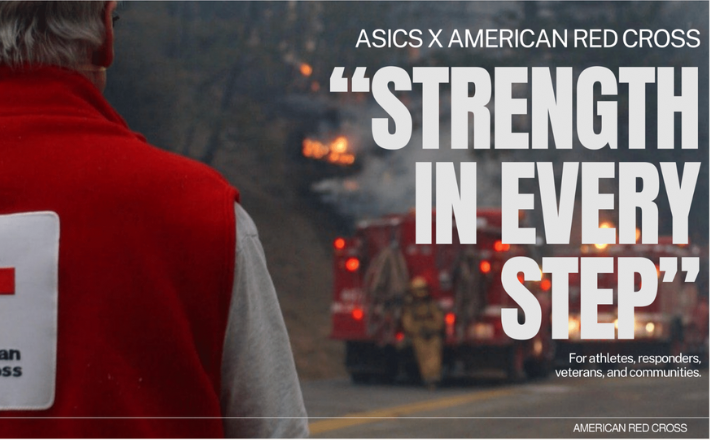
Strength in Every Step by Ashton Lovette brings together ASICS and the American Red Cross to reimagine how movement can support community resilience, pairing performance design with accessible programs that translate everyday action into meaningful, real-world impact.
TREND 4: CIRCULAR SYSTEMS AND WASTE-TO-VALUE MODELS
Sustainability featured prominently in the 2026 case studies through concrete systems designed to extend product lifespans and reduce waste. Scholars focused on rental models, closed-loop recycling, and material reuse as practical frameworks.
In The NU Way to Travel, Bridget Flatow from The University of Texas at Austin positioned wardrobe rental as a travel utility through Nuuly and Airbnb. Second Skin, Second Life by Azaria Smallwood from RISD proposed a closed-loop recycling model with Peachaus and TerraCycle. Stadium Waste to World Cup Style by Andrea Avalos Lujan from Cal Poly Pomona explored how event waste is transformed through Stüssy and FIFA.
Together, these projects treated sustainability as a practical design approach, focused on extending product life and keeping materials in use.
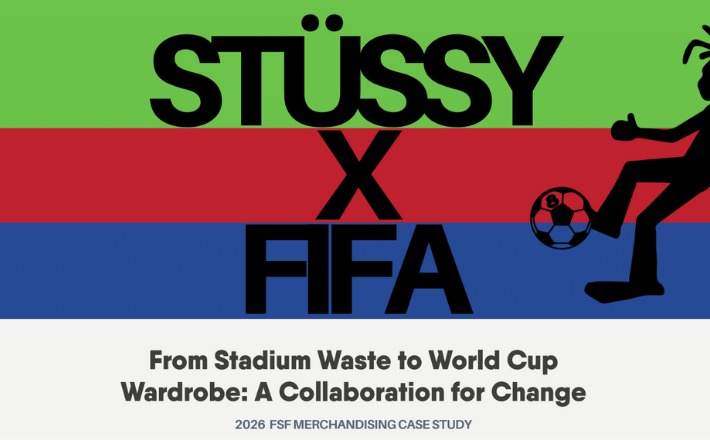
Stadium Waste to World Cup Style by Andrea Avalos Lujan transforms stadium waste into limited-edition World Cup jerseys, using recycled materials to connect sport, streetwear, and sustainability through a product that balances cultural relevance and environmental impact.
TREND 5: SPORTS AND FANDOM AS CULTURAL PLATFORMS
Sports emerged in the 2026 case studies as a powerful cultural force, with Scholars drawing on the rituals, loyalty, and shared experiences that shape fandom and influence how fashion connects people to community.
The Modern Fan Capsule by Ellie Draus from Columbia College Chicago applied gender-inclusive thinking to fan apparel, using a Miu Miu and NFL collaboration to design fashion-forward pieces meant to move across sport, street, and everyday wear. Full Throttle. No Brakes. by Angelina Woodall from Arizona State University translated motorsport culture into lifestyle fashion with Diesel and Formula One. From Hardwood to Hype by Kennedy Hoyt from Spelman College positioned youth basketball culture through Eric Emanuel and Overtime Elite. Reconstructed26 by Maddy Osborne from SCAD Atlanta explored heritage and collectibility through Thom Browne and Major League Baseball.
These case studies treated sports as a living cultural engine that shapes style, aspiration, and community across generations.

Full Throttle. No Brakes. by Angelina Woodall imagines a collaboration between Diesel and Formula One that translates the intensity of motorsport into a limited-edition collection designed for both digital and in-person audiences.
TREND 6: PURPOSE BUILT INTO PARTNERSHIP MODELS
Purpose-driven thinking showed up across the 2026 submissions, with Scholars creating partnerships that support community needs through clear programs tied to product, access, and services.
Pass The OJ: From Our Table to Yours by Ahmere Harper from Hampton University explored food access through Ralph Lauren and City Harvest. Bride of Nature by Ainsley Parker from Virginia Commonwealth University connected craftsmanship and conservation through Gabriela Hearst and the National Park Foundation. United in Purpose by Lily Arnold from SCAD Savannah aligned durability and humanitarian aid through Carhartt and Mercy Corps.
These projects positioned fashion as a tool for participation, visibility, and community support.
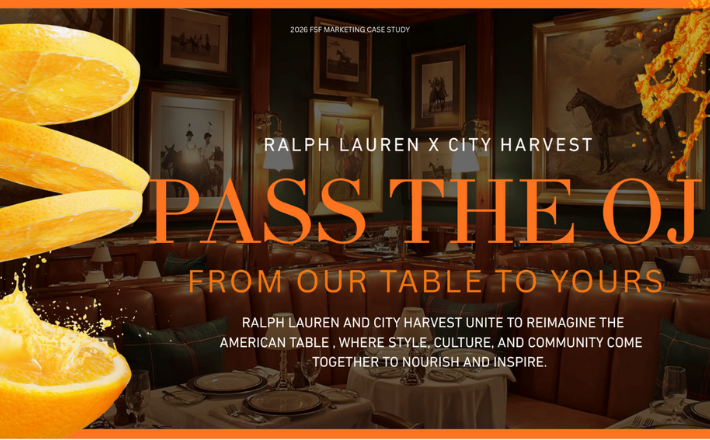
Pass The OJ: From Our Table to Yours by Ahmere Harper uses product, storytelling, and community programming to support food access and address food insecurity.
THE CLASS OF 2026 SEES FASHION AS A CONNECTED SYSTEM
Across disciplines, the Class of 2026 approached fashion as a connected system, designing work that brings product, experience, and purpose into closer alignment. These case studies reflect a generation prepared to lead with clarity, creativity, and care, using fashion to create meaningful value beyond the product itself. The future of fashion is being shaped by how these Scholars connect ideas, industries, and people.
To see more winning case studies from, check out the FSF Class of 2026 directory.