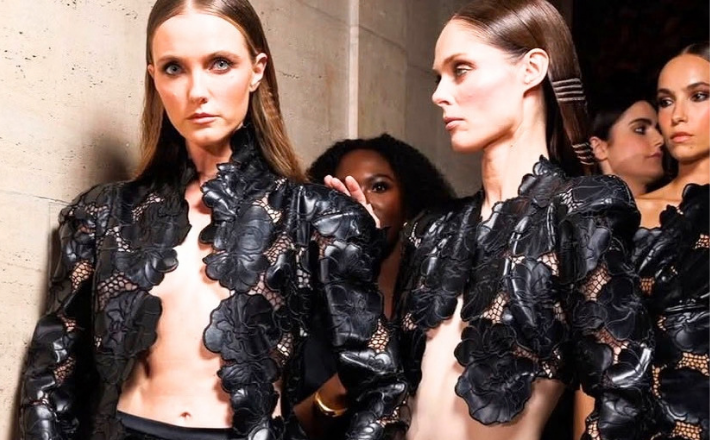
At 2 p.m. on September 11, Emonie Coleman, a 2025 and 2026 Virgil Abloh™ “Post-Modern” Scholar, Columbia College Chicago graduate, and founder of Star Market Chi, was an hour away from opening the doors to a New York Fashion Week runway show.
Some of her models still hadn’t arrived. TSA had confiscated the props she was expecting because they contained liquid. She had no dedicated assistant or additional dresser, and a venue change the week before had already forced the production team to rethink how the show would run.
Emonie stepped away for a minute, said a prayer with a friend, and called a trusted mentor for perspective.
“She gave me encouraging words and pointers that helped me throughout the show and brought me back to my A-game,” Emonie said.
Then she went back to work.
This season, across New York Fashion Week, Fashion Scholarship Fund Scholars got a close look at the work that happens before, around, and beyond the runway. They constructed garments, managed fittings, dressed models, styled performers, produced events, and supported the teams behind one of fashion’s most visible weeks.
For students and recent graduates entering the industry, Fashion Week offers something different from seeing a finished collection from the audience. It puts them inside the process.
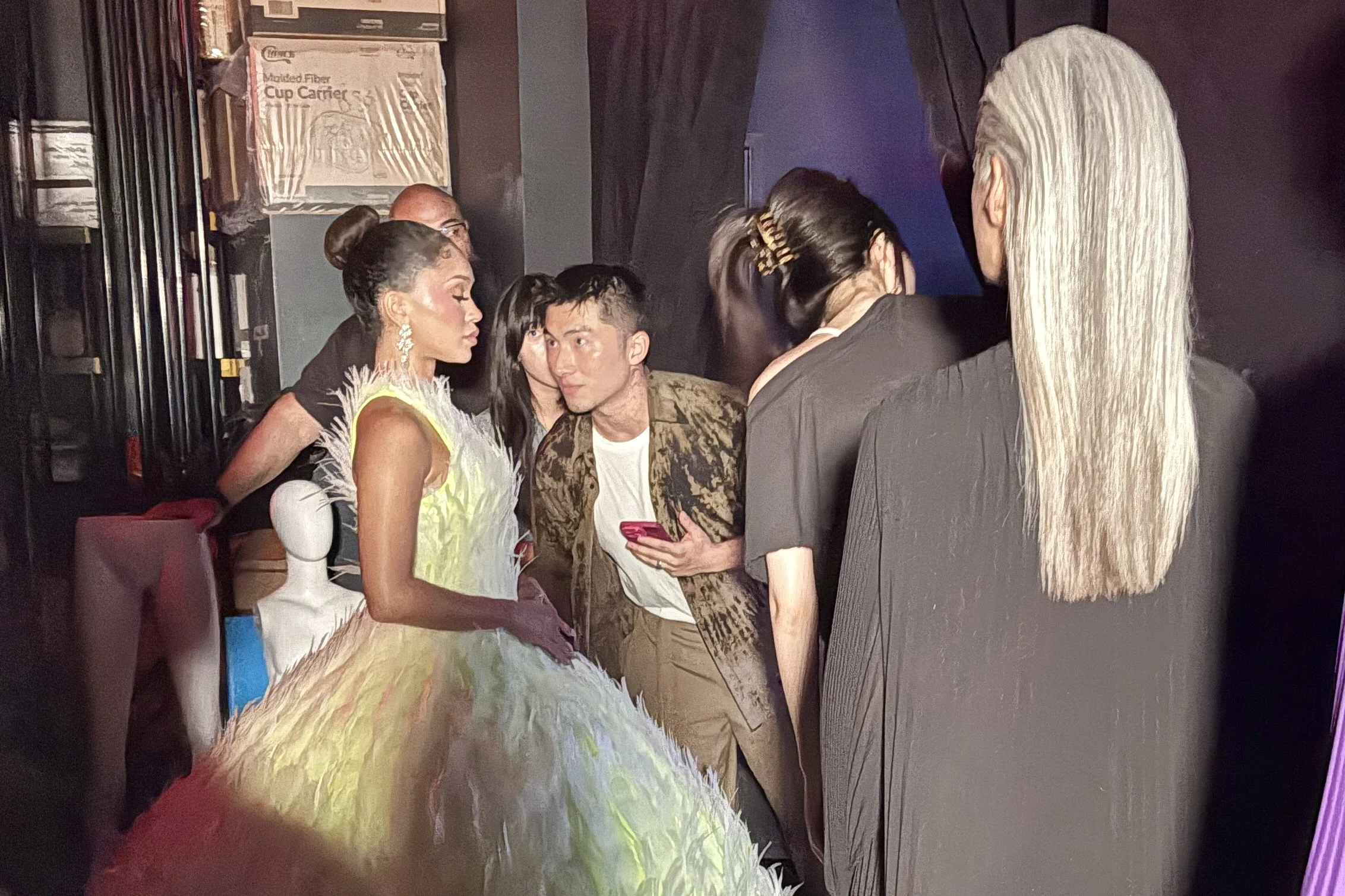
Behind the scenes at Bad Binch Tong Tong. Photo courtesy of Lily Arnold
ITHE WORK BEFORE THE RUNWAY
Benicio Gomez had been working at LUAR for about a month when the brand presented its collection.
A 2025 and 2026 Virgil Abloh™ “Post-Modern” Scholar and graduate of Virginia Commonwealth University School of the Arts, Benicio joined a small team where the work crossed several stages of development. He patterned, cut, and sewed samples; helped finalize patterns for in-house production; sourced and prepared fabrics; distressed garments; and worked on both runway and custom pieces.
“I was able to be hands-on with almost everything,” he said.
That included Look 9, which featured a moiré skirt Benicio helped an in-house tailor pattern, fit, cut, and construct. Working alongside the tailor gave him a chance to sharpen his technical skills and build relationships within the team.
As the show approached, fittings, alterations, production deliveries, and the remaining checklist compressed into longer days and later nights.
“There isn’t a fashion show without a late night or week beforehand,” Benicio said. “The saying that ‘fashion isn’t glamorous’ rings true. There’s nothing to describe the scent of a studio that has been on 24/7, and how fluorescent lights feel in the middle of the night.”
At Bad Binch Tong Tong, 2026 Scholar and Savannah College of Art and Design grad Lily Arnold also worked across several stages of the collection, taking on patternmaking, sewing, design, production, and logistics. The range of responsibilities surprised her, but became one of the things she valued most about the internship.
The small, close-knit team gave Lily room to contribute beyond garment construction. Designer Terrence Zhou invited interns’ opinions on styling and the show’s overall presentation, while trusting them with production responsibilities that showed them what bringing a collection to Fashion Week involves.
Like Benicio, Lily spent long nights working alongside the team. Those hours ultimately stayed with her more than the finished presentation.
“When I reflect back on my internship, it was the late nights working with people that was most memorable,” she said.
For Azaria Van Der Stok Smallwood, the months surrounding Fashion Week have offered two different views of the same process.
Azaria, a 2026 Virgil Abloh™ “Post-Modern” Scholar, graduated from the Rhode Island School of Design this spring and moved directly to New York City, where she began dividing her week between design internships at Christian Siriano and LaQuan Smith. At LaQuan Smith, she has worked across material sourcing, technical design, sample management, fittings, and ready-to-wear development. At Christian Siriano, her responsibilities have brought her into the atelier, where she works on pattern adaptation, draping, garment construction, and couture finishing.
“Balancing these two roles has given me an unparalleled education in both the creative and technical dimensions of luxury fashion,” Azaria said, “while also teaching me what it takes to operate a fashion house in New York City's fast-paced, globally influential design industry.”
The opportunities grew from relationships she began building through FSF before graduation. At this year’s FSF Live Gala, Azaria presented her thesis collection, Denouncing Panopticism, to Christian Siriano and members of his design team.
Other Scholars were getting their own look at the work leading up to a show. Camryn Swain, a 2026 Virgil Abloh™ “Post-Modern” Scholar from Hampton University, interned with both KidSuper and LaQuan Smith during Fashion Week. In one behind-the-scenes reel shared by FSF, she can be seen assisting with pre-show styling for KidSuper’s The People’s Runway.
These experiences show how many decisions and hours of work sit between an initial idea and a finished garment. By the time a runway look reaches an audience, someone has cut it, fitted it, altered it, sourced the material, solved the construction problem, and stayed late enough to finish it.
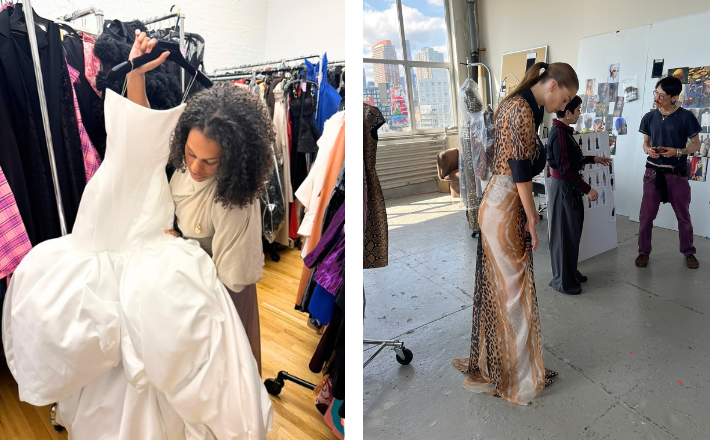
Behind the scenes at Christian Siriano (left) and LaQuan Smith (right). Photos courtesy of Azaria Van Der Stok Smallwood
WORKING WHEN THE PLAN CHANGES
The closer Scholars got to live production, the less fixed their responsibilities became.
For Lily, show day at Bad Binch Tong Tong meant assigning looks to dressers, checking that garments were styled and fitted correctly, and helping keep backstage preparations moving before models walked the runway. Her work extended beyond the presentation itself—she also helped set up the show, break it down, and return materials to the studio.
“It was exhilarating and so much hard work,” she said, “but I really cherish my memories and the people I met along the way.”
Chloé Jean-Miles, a 2026 FSF Scholar, Savannah College of Art and Design graduate, and founder of MoochNails, was interning with KidSuper during the brand’s People’s Runway. She organized racks, steamed clothing, assisted participating designers, and dressed models, including the mother of head designer Colm Dillane.
Then Wyclef Jean arrived as a surprise performer. Chloé, who is his niece, was asked to style him.
“It really takes a village,” she said. “There are so many people who come together to make one event happen,” including teams working across set, lighting, music, modeling, glam, sewing, and wardrobe.
At KidSuper, Chloé saw how often those roles overlapped on a small team. After Fashion Week, she was invited to continue interning with the brand and has kept learning how the team works across its shows, pop-ups, and day-to-day business.
Camryn saw another side of that environment. A second reel FSF shared captures her perspective backstage at KidSuper’s Spring/Summer 2027 show and the coordination behind a live runway production.
Emonie was managing that same kind of overlap from the producer side.
In addition to presenting seven Star Market Chi looks in the Kailinciaga Events runway show, she organized a Brooklyn pop-up for her own brand alongside Chicago designer Kendyl Delyse and Los Angeles-based Ferocity. She designed the marketing flyers, found the DJ, coordinated garments coming to New York, and helped shape the event’s theme and flow.
Emonie had attended Fashion Week twice before and wanted to challenge herself to host an event of her own. This time, she was responsible for what guests saw, as well as much of what happened before they arrived.
By the end of the week, what stayed with her most was how everyone responded when things changed.
“The most memorable for me was seeing how adaptable everyone was,” she said. “Even under pressure, the models worked swiftly and still did a really great performance on the runway.”
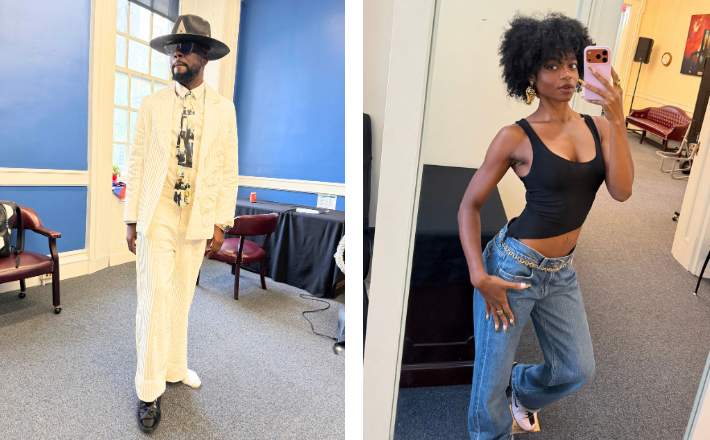
Behind the scenes at KidSuper: The People’s Runway with Wyclef Jean (left) and Chloé Jean-Miles. Photos courtesy of Chloé Jean-Miles
WHAT A FASHION EVENT DOES FOR A BRAND
Working with KidSuper gave Chloé a closer look at how the brand uses fashion shows and pop-ups in its marketing. The investment is in the experience itself: creating something people can step into, remember, and associate with the brand.
That idea felt relevant to Chloé’s own work. She is the founder of MoochNails, which she describes as the first press-on nail fashion house, and her interests already move across fashion, beauty, marketing, and entrepreneurship. During the KidSuper x Fugees pop-up after Fashion Week, she had the opportunity to gift Lauryn Hill a custom set.
“I’m just overall grateful for having the opportunity to spread my wings in multiple different lanes of fashion and lifestyle,” Chloé said.
Emonie reached a similar conclusion from the producer's side. Producing her own pop-up showed her how much work goes into creating an environment around a brand, and why that environment matters.
“[I learned] how important it is to build a world around your brand that people want to come visit,” she said.
She also left with a clearer sense of what she would change next time, including starting earlier and putting more time and money toward production. After managing the venue, marketing, garments, collaborators, logistics, and guests herself, she no longer sees those decisions as theoretical.
Asia Hertz, a 2026 Virgil Abloh™ “Post-Modern” Scholar at Academy of Art University, saw Fashion Week from another part of the business. As part of her internship with LaQuan Smith’s marketing team, she worked on the designer’s Spring/Summer 2027 runway show and shared a behind-the-scenes look at the production.
Across these experiences, Scholars saw how many different jobs converge around a Fashion Week show. Design, production, styling, marketing, events, and technical work may lead to the same runway, but each role is distinct.
That kind of access can make a career path more concrete. Scholars leave with a clearer understanding of the roles involved, how teams work together, where the pressure points are, and which parts of the process they want to pursue further.
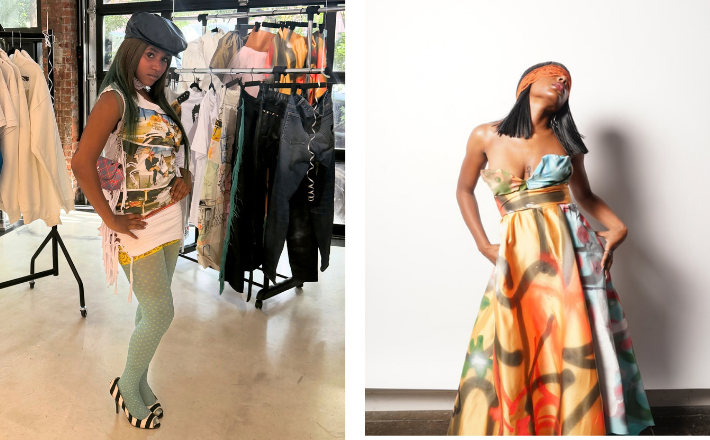
Photos courtesy of Emonie Coleman