



By Janelle Sessoms | Janelle Sessoms is a staff writer at Fashionista.
Colby Zur, a senior apparel design major at Colorado State University and 2025 Fashion Scholarship Fund (FSF) Scholar, says many of his peers have struggled to land summer internships in fashion.
They either couldn't land one, he says, or the ones they did find weren't design-related: "Right now, getting a foot in the door seems like the hardest thing [about] getting into the industry before graduation."
It's an industry-wide problem. The FSF, a nonprofit that directly provides students with career opportunities, mentorship, networking, financial aid and professional development, is typically a go-to source for companies to recruit young talent. But its Executive Director, Peter Arnold, has noticed that fewer industry partners are filling entry-level creative roles.
"It was definitely harder this summer for our students who are pursuing design disciplines and product development disciplines to get a summer internship," he states. "I think students are feeling the pressure of knowing that there aren't a lot of those opportunities and that it may not be upon graduation that you land that dream job, because there aren't that many dream jobs being offered up."
The FSF tries to help where it can. For instance, the organization helped Gabrielle Ribot, a senior fashion design student at FIT and 2025 Virgil Abloh "Post Modern" Scholar, land her first product development internship at Aknvas, followed by a design internship at Carolina Herrera. But her experience is slowly becoming the exception, not the rule.
Students are feeling the effects of widespread instability — think: tariff chaos, inflation, shrinking budgets and shifting consumer habits — just as much as industry professionals. Internships are more competitive than ever, leaving some students scrambling to build their resumes before graduation. And their post-graduation career options may not be as strong as they'd expected.
However, all hope is not lost: Many students remain optimistic about the future of fashion, and are becoming more interested in industry developments like artificial intelligence and sustainability.
Ahead, students and educators discuss these and other key industry shifts, and how they're influencing the next generation of designers' career pursuits.
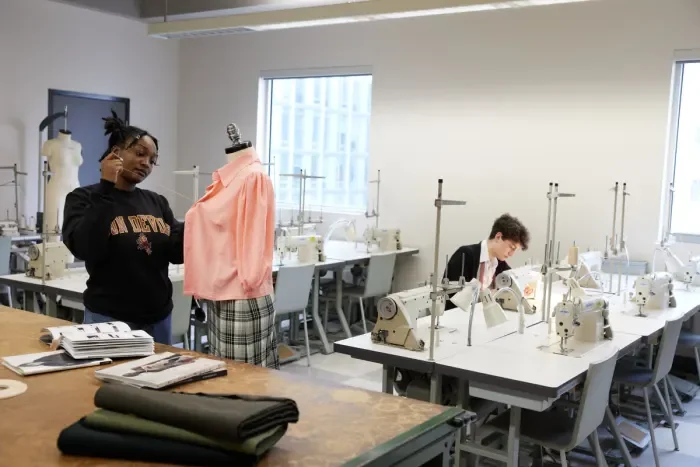
Photo: Courtesy of ASU FIDM
Sustainability
"Things like circularity and upcycling are really, really important to the students that we talk to, and they're very committed to working at a brand that has embraced those same precepts," says Arnold.
Sustainability is now more than a mere classroom roundtable discussion topic or project prompt — it's a defining work value for many students, like Zur.
"I am starting to want to approach [sustainability] a lot differently because I don't really like the way that most brands are doing it," Zur says, lamenting their overall lack of systemic change and true transparency. That's not to say sustainability is dictating all his career moves, though: This summer, he landed an internship at Sitka, a high-end technical hunting gear brand. The company is admittedly not the most environmentally conscious, but Zur's priority was getting work experience.
"It was a sacrifice I was fine making because there was so much to learn from them," he explains. "But once I'm at a place where [I've been] working a lot longer, I think that would be important."
"Sometimes you have to take a job if you need to pay the bills," adds Paris Liu, a 2025 FIT fashion design graduate and Critic Award winner. "But people do consider sustainability if they can. It's something our professors do make us consider. They're like, 'Are you working for a brand that can afford to be sustainable?'"
ASU FIDM's assistant director of Student Success and Engagement, Miguel Barragan, is hopeful that, as sustainability becomes more integrated into company operations, it will lead to newly formed roles like director of production or vice president of sustainability. It's why the school is thinking of new courses and classes centered around the subject, so students can "adapt to and build those careers," he says.

Parsons MFA 2023 Runway Show.
Photo: John Lamparski/Getty Images
Luxury Brands and Their Ever-Changing Creative Directors
How are design students processing the head-spinning amount of creative director switch-ups? Some enjoy following along, while others remain indifferent. Either way, it doesn't seem to be discouraging them from pursuing jobs at these fashion houses.
"It doesn't really have much sway for me," Zur explains. "When I came into school for apparel design, I knew nothing about the broader industry."
Other students find the creative director musical chairs intriguing. "I don't think they find that destabilizing. I think they find it exciting," says Arnold. "I think they think, 'Oh, with change comes opportunity.'"
Fiona Otto, a senior fashion design major at ASU FIDM and 2025 Virgil Abloh "Post Modern" Scholar, aspires to be a creative director at a couture brand — specifically Valentino or Schiaparelli — and is excitedly following every new major hire or exit. "Every time there's a new creative director, my friends and I at school always talk about it, like how their visions will change the brand," she shares.
Barragan confirms that creative director roles at luxury houses remain a popular career aspiration. And while he loves the enthusiasm, "let's first figure out what we need to do to get there," he says. "A lot of our students take these big internship programs, whether it's Abercrombie & Fitch or Victoria's Secret. When it comes down to your first career placement, having that internship experience really puts you in a position to then be able to apply to the Louis Vuittons of the world, to the designer world."
Fiona Dieffenbacher, Parsons' associate dean of the School of Fashion, echoes his sentiment: "We're trying to encourage our students to really see entering at any level of the market as a successful aspiration."
For Liu, while working at a big European house would be a thrill, she and her peers are fine sticking to American labels across the mass, contemporary and luxury markets. It has nothing to do with the creative director changes, and more to do with it being more realistic (and perhaps financially prudent) goal.
"There is more money towards the mass market end of brands, and I think people appreciate that when rent is high," she laughs. "I know some students who love a couture brand, but it's a little hard, if you're starting in the U.S., to work in Europe anyway."
Photo: Getty Images
The Indie Brands
Despite indie fashion being hit hard by economic turmoil and retail closures, some young creatives are still betting on building careers in that sector. Compared to mass labels, independent brands promise a more hands-on, well-rounded experience.
"Most of my peers and I would be interested in working for an indie brand if they had a position available," Liu says. "When you're young, you don't have a family to support, so you can kind of take the chance with an indie brand a bit more, even if the salary might not be as great. They may have values that you also have."
For many emerging talents, the ideal endgame is to get that work experience before branching out to start their own brands.
"Maybe 10 years ago or even beyond, [graduates] were all ready to just go launch a label," says Dieffenbacher. "But there are fewer jobs and also less money around." Joining an indie label allows students to see firsthand what it takes to launch a brand with a small team and limited budget, she adds; plus it can help them build relationships with production teams and sample makers.
Ribot aspires to work as a design director in Paris before venturing out on her own, but she's open-minded when it comes to the type of brand. "Fashion is a business at the end of the day, so I would love to get as much experience as possible [for] when I start my brand one day," she emphasizes.
Additionally, not every student is looking to create a multi-million-dollar business: Some are in it for the artistry, not the money, Arnold notes. "People are much more comfortable thoughtfully growing something creatively and keeping it contained and not scaling it and not going to the next tier," he explains. "They're happily like, 'I'm able to create and do what I do and break even if not make a little money, and that is all I want to do.'"
Photo: Getty Images
The Rise of AI
Not unlike established designers, the next generation of creatives has mixed feelings about AI.
On one hand, some students are skeptical about AI's role in fashion. Arnold points out that the technology represents a completely different dimension of the creative process, which can scare away designers who view fashion through a pure and raw lens.
"AI's role is not quite fully integrated into what you're learning," he says. "I hear that from a lot of our educators. There are students who are not embracing it, surprisingly, because there is this perception that, 'Well, it's going to inhibit my learning to be creative.'"
On the other hand, some students are embracing its benefits, seeing it as a tool to make design more efficient, and aren't worried about it replacing jobs.
"Even though AI seems scary, I think that it could be really helpful in the design process," Ribot expresses. "I don't really think it's going to replace designers altogether because there has to be that story behind each brand and there has to be a person behind that story."
At ASU FIDM, the school introduced a new course, titled "AI in Fashion," that explores how to apply the technology to fashion design, merchandising and retail. "It's a tool to give clarity to our creativity," Barragan explains. "I think we as creatives can have so many ideas, and to tell you what that idea is, I need to put it into a PowerPoint or a deck or a sketch or a combination of these things. In order to give focus to my creativity and communicate it with you, AI is another tool that we can use in this way of communication."
That's not to say fashion schools are giving students free rein to use AI as the please. Parsons has put AI policies into its courses, although professors have flexibility in adapting them to their own teachings. In general, most educators ask students to disclose when they use Chat GPT or another AI tool on a project or in their work process. But overall, the school sees AI as a helpful tool for creatives.
So, how is AI relevant to early career pursuits? While students aren't letting the technology influence the job titles or brands they're pursuing, it is seen a helpful skill to add to their resumes.
"It's a really good asset to have," Dieffenbacher concludes. "Using these tools in a higher way of creativity, students can add it to their portfolios, use it in their projects and they will be able to integrate it for their communication skills."